Every gemstone has its own personality, and its own needs. This guide covers the stones I work with most often, including diamond, sapphire, tourmaline, garnet, moonstone, labradorite and opal, how hard each one is, and how to keep it looking its best. For general care of your metal and everyday habits, see Jewellery Care.
The Mohs scale ranks minerals from 1 (the softest, talc) to 10 (the hardest, diamond) by how well they resist being scratched. It’s a ranking rather than an even scale, so each step up isn’t the same amount harder. Diamond, for example, is far harder than sapphire, even though they sit just one number apart.
One number is especially useful to remember: 7. Everyday household dust contains tiny particles of quartz, which has a hardness of 7, so stones softer than that can gradually pick up fine scratches from ordinary contact. That’s why the softer stones below benefit from extra care and their own storage.
Here’s a quick reference for every stone in this guide, from hardest to softest. You’ll find more detail on each one below.
| Gemstone | Mohs | Everyday wear | How to clean | Avoid |
|---|---|---|---|---|
| Diamond | 10 | Hardest of all gemstones; suits everyday wear | ||
| Sapphire | 9 | Excellent for everyday wear | ||
| Tourmaline | 7 – 7.5 | Good, with sensible care | ||
| Garnet | 6.5 – 7.5 (varies by type) | Good, with sensible care | ||
| Moonstone | 6 – 6.5 | Wear with care; lovely in pendants | ||
| Labradorite | 6 – 6.5 | Wear with care; lovely in pendants | ||
| Opal | 5.5 – 6.5 | Wear with care; the most delicate |
Hardness tells you how well a stone resists scratches, not how well it copes with a knock. Some stones, like moonstone, can split along natural internal planes. Natural inclusions and tiny fractures can make a stone more vulnerable to a sharp blow, and pointed shapes such as hearts and kites are most at risk at their tips. Heat, dryness and chemicals also affect some stones, like opal, regardless of how hard they are.
The table above is the quick how-to. Open a stone below to learn about its character, how best to wear it, and why it needs the care it does. You can also choose a stone’s name in the table to jump straight to it.
Diamond is the hardest natural material, formed deep in the earth under extreme heat and pressure. Colourless stones are the classic, but diamonds also come in soft champagne, grey and salt-and-pepper tones, each with its own character.
Diamond suits everything, including rings worn every day. Its hardness means the polish stays crisp for decades.
Hard isn’t the same as tough. Diamond can split along internal planes, so a sharp knock on an edge or corner can chip it. It also attracts grease from skin and lotions, which is why a diamond can look cloudy until it’s washed.
A diamond will scratch every other gemstone and any metal, so keep it apart from the rest of your jewellery.
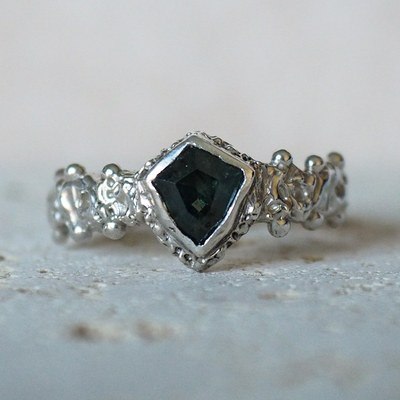
Sapphire is the gem form of corundum, coloured by tiny traces of other elements. Blue is the classic, but sapphires come in almost every colour, including pink, teal, green, yellow and white. Only red corundum has its own name: ruby. Australia has a long history of producing sapphires, often in deep blues, greens and teals.
Shown: Arden
Sapphire is an excellent choice for rings and everyday wear, and it holds its polish beautifully.
Its hardness protects it from scratches, but the corners of pointed cuts, such as kites and hearts, are the most exposed spots. A hard knock against a bench or stone surface is the most common cause of a chip, so it’s worth taking rings off for heavy jobs.
Heat treatment to improve colour is a common, widely accepted practice with sapphires. If you’d like to know about the stone in your piece, just ask me.
Tourmaline has one of the widest colour ranges of any gemstone, from soft pinks and fresh greens to deep blue-greens and indigo, and even two-tone “watermelon” stones. Many tourmalines contain natural inclusions, which are part of a stone’s character.
Tourmaline is reasonably durable, so it suits rings with sensible care. It’s especially at home in pendants and earrings, which see fewer knocks.
Tourmaline is fairly hard but can be brittle, and the inclusions inside many stones make them more likely to chip from a sharp knock, or to crack with sudden temperature changes. It can also attract dust and lint when it’s warmed or rubbed, so an occasional wipe keeps it looking clear.
A single tourmaline crystal can shade from one colour to another along its length, which is why bicolour and tricolour stones exist.
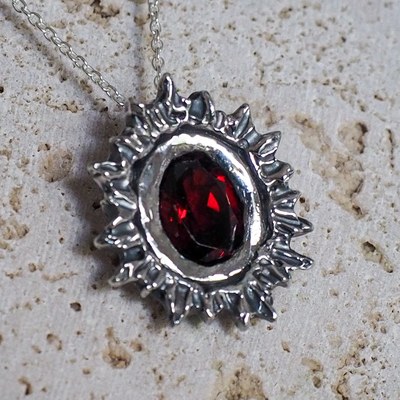
Garnet is a family of stones rather than a single one, ranging from the deep reds most people picture to orange, golden and vivid green varieties. The rich red garnets used in jewellery have a warm, glowing depth that suits both silver and gold.
Shown: The Maker’s Pendant — Sol
Most garnets are durable enough for everyday rings with sensible care, and they’re especially lovely in pendants and earrings.
Garnets sit around 7 on the Mohs scale, which is durable but not immune to chips or scratches, especially from harder stones such as sapphire and diamond. Keeping garnet jewellery separate protects its polish.
The name comes from the Latin word for pomegranate, after the resemblance of small red garnets to the fruit’s seeds.
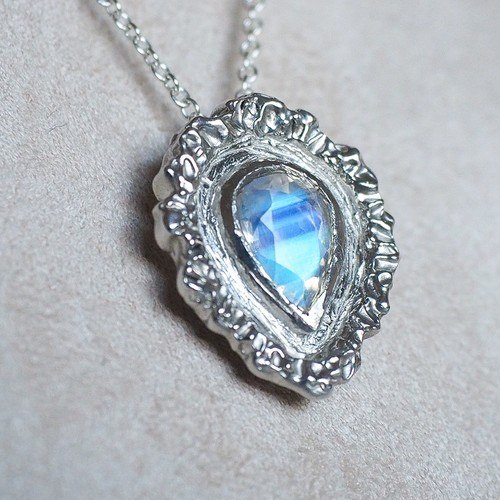
Moonstone is known for its adularescence, a soft blue-white glow that seems to float just under the surface and shifts as the stone moves. It comes from microscopic layers inside the stone that scatter the light.
Shown: A Maker’s Pendant in Tide
Moonstone is happiest in pieces that see fewer knocks, such as pendants and earrings. If it’s set in a ring, it’s best kept for occasions, or taken off for anything hands-on.
Moonstone is softer than most gemstones and has natural cleavage planes, so a sharp knock can split or chip it. It also scratches more easily, which is why it’s best stored on its own, wrapped in a soft cloth.
The glow is strongest from one angle, so turn the stone under the light to find it. Domed cabochon cuts show it best.
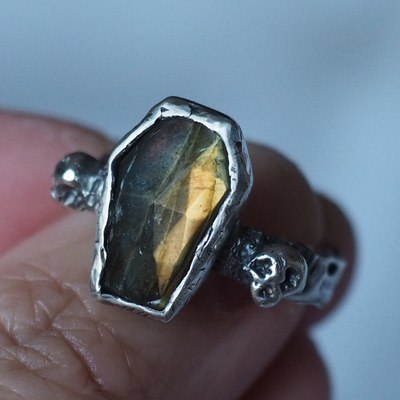
Labradorite is loved for labradorescence, flashes of blue, green, gold and sometimes orange or pink that appear as the stone catches the light. It’s a feldspar, like moonstone, and takes its name from the Labrador coast of Canada.
Shown: A labradorite coffin ring
Like moonstone, labradorite suits pendants and earrings best. In a ring, take it off for anything hands-on.
It shares moonstone’s softness and natural cleavage, so knocks are the main risk, and heat and harsh chemicals are best avoided too.
The colour flash usually appears from one direction only, so the stone can look dark grey until you tilt it. That reveal is part of its charm.
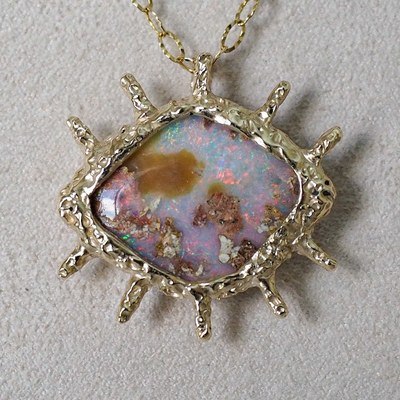
Opal is made of microscopic spheres of silica arranged in a regular pattern that splits light into flashes of colour, known as play-of-colour. Australia produces the majority of the world’s precious opal. Boulder opal, from Queensland, forms as thin seams in ironstone and is often cut with some of the brown host rock left attached, which adds both strength and contrast.
Shown: Oculus
Opals are lovely in pendants and earrings, where they’re protected from knocks. In a ring, they suit occasions better than daily wear.
Opal contains a small amount of water and is softer than most gemstones, so it doesn’t like heat, dryness or sudden temperature changes, which can cause fine cracks known as crazing. Knocks can chip it, and harder materials can scratch it.
Natural opals often show host rock or small inclusions. These are part of the stone and not damage, and they make every opal one of a kind.
If a stone ever looks chipped, cracked or loose, please stop wearing the piece and get in touch.
I sometimes work with other stones, particularly on bespoke pieces. If your piece is set with a stone that isn’t covered here, I’m always happy to share how to care for it. Just get in touch.
Please email me at hello@maisonchar.com and I’ll be happy to help.